

A medico-legal case involves more than an assessment: timing, records, relevant expertise and follow-up all affect how clearly the matter can be evaluated. In South Africa, a medico-legal case concerns a medical matter with legal implications for the attending doctor, where circumstances may warrant investigation by law enforcement. Medico-legal case management coordinates the claimant and expert process, including appointment scheduling, documentation and communication. This guide explains what “medico-legal” means and how to coordinate claimant and expert pathways, from identifying appropriate expertise and arranging assessments to sequencing appointments around complex injuries and rehabilitation needs. It also covers the information that supports an organised process, what claimants and experts can expect from scheduling, and how clear coordination helps legal teams and insurers understand next steps while keeping individual assessment and rehabilitation needs in view.
Key Takeaways
- Understand when a medical matter may have legal implications and why clear records and coordination matter.
- Learn how claimant and expert journeys can be organised so relevant documentation and assessments are aligned.
- See how injury type, functional needs and rehabilitation considerations can shape an assessment pathway.
- Find out which practical details help coordinate medico-legal assessment appointments and keep the process moving.
Coordinating claimant and expert journeys
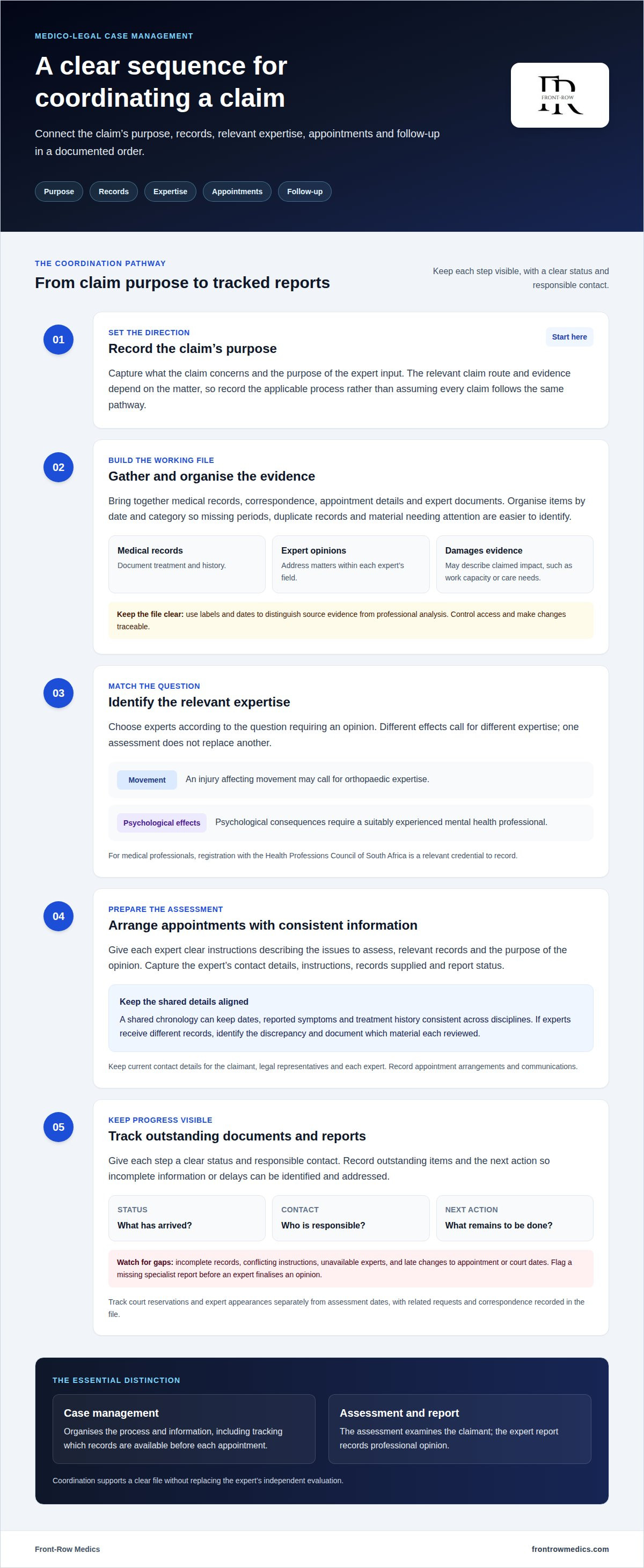
A medico-legal matter has legal implications and may require investigation, while an assessment and report provide expert evidence. Coordination connects the claimant’s records, relevant experts, appointments and claim documentation in a clear, documented sequence.
Centralised claimant document storage
A central claimant file brings together medical records, correspondence, appointment details and expert documents. Organising items by date and category helps identify missing periods, duplicate records and material requiring attention. Access should be controlled and changes traceable, keeping the working file coherent as information arrives. For example, a hospital record and a later specialist opinion can be filed separately and reviewed in sequence against the claimant’s history.
This is a practical distinction between coordination and assessment: case management organises the process and information, while an assessment examines the claimant and an expert report records professional opinion. A coordinator can track which records are available before each appointment without replacing the expert’s independent evaluation.
Claims handling
Claims handling support organises the administrative process from initial screening through expert appointments and evidence collation. A workable sequence is to record the claim’s purpose, identify relevant records, determine the expertise needed, arrange assessments, then track outstanding documents and reports. Give each step a clear status and responsible contact so delays or incomplete information can be identified and addressed.
For military claims, the file can distinguish service-related records from later treatment, civilian employment evidence and other claim material. The relevant claim route and evidence depend on the matter, so coordination should record the applicable process rather than assume every military-related claim follows the same pathway. This keeps communications between the claimant, representative and expert focused on the right documents and next action.
Managing records, opinions and damages evidence
Medical records, expert opinions and damages evidence serve different purposes and should remain identifiable in the same claim file. Medical records document treatment and history; expert opinions address matters within each expert’s field; damages evidence may include material about the claimed impact, such as work capacity or care needs. Clear labels and dates help distinguish source evidence from professional analysis.
In practice, coordination records what has arrived, links each opinion to the records considered and notes outstanding evidence. This gives the legal team a clearer view of the file’s progress while preserving the distinction between clinical findings and legal argument. For a South African claim, keep communications and supporting material organised around the specific claim pathway and its requirements.
Experience with medicolegal and case-managed clients
In South Africa, medico-legal case management coordinates claimant information, expert input and administrative steps in a legal matter. Medical practices and medico-legal coordination providers may support this work, while attorneys direct the legal case.
Consistent information across experts
Each expert needs clear instructions describing the issues to assess, relevant records and the purpose of the opinion. A shared chronology can keep dates, reported symptoms and treatment history consistent across disciplines. If an orthopaedic expert and psychologist receive different records, the coordinator should identify the discrepancy and document which material each reviewed. This preserves clarity without asking experts to reach the same conclusion.
Medical expert selection and appointments
Choose experts according to the question requiring an opinion. An injury affecting movement may call for orthopaedic expertise, while psychological consequences require a suitably experienced mental health professional. Medical experts need relevant clinical expertise and an understanding of the medico-legal context. For medical professionals, registration with the Health Professions Council of South Africa is a relevant credential to record. The appointment process should also capture the expert’s contact details, instructions, records supplied and report status.
Contact management means keeping current details for the claimant, legal representatives and each expert, then recording appointment arrangements and communications. Track court reservations and expert appearances separately from assessment dates. A medical provider may be called to court as an expert witness alongside the relevant medical records, so the file should record the appearance request and related correspondence.
No single qualification or rule applies identically to every coordinator, expert and claim. Appropriate standards depend on each professional’s role, while court procedure depends on the forum and case. When selecting a provider, consider relevant experience, professional standing, clear instructions and documented information handling.
Common delays include incomplete records, conflicting instructions, unavailable experts and late changes to appointment or court dates. Recording each outstanding item, its responsible contact and the next action makes follow-up visible. For example, flag a missing specialist report before an expert finalises an opinion, rather than discovering the gap as the legal team prepares the case.
Complex injury and rehabilitation case types
A complex injury may affect movement, psychological wellbeing, work capacity and daily activities. Orthopaedic and psychological assessments answer different questions, so coordinate their evidence without treating one expert’s findings as a substitute for another’s. An orthopaedic opinion, for example, may address physical impairment, whilst a psychological assessment considers emotional effects.
The assessment pathway should match the injury and the issues requiring evidence. First, organise relevant medical history and treatment records for each expert. Next, instructions should identify the questions each discipline must address. Where an injury has both physical and psychological consequences, separate appointments can produce distinct opinions for the legal team to consider together.
Rehabilitation planning depends on the claimant’s functional needs, not just the diagnosis. A case manager may help assess support for daily activities, including shopping and paying bills, as well as access to education and social participation. Record these practical needs separately from clinical findings so the evidence can explain how an injury affects everyday life.
Work capacity is another consideration in injury and disability claims. An assessment may help clarify which tasks a person can perform, which activities are restricted and what support or adjustments may be relevant. A claimant’s physical limitations, for example, could affect workplace duties differently from household tasks. Keeping these distinctions clear helps connect medical evidence with rehabilitation and return-to-work planning.
Road Accident Fund (RAF) matters may involve case management after settlement, once the quantum amount is finalised and where no trust or curator bonis is appointed. In this context, a case manager may assess needs and advise on services or products required to support the claimant. The timing and purpose differ from expert assessments, which address medical questions and provide professional opinions for the case.
For each complex injury, coordinate the expert’s field, the claimant’s functional concerns and the relevant stage of rehabilitation. This helps legal teams distinguish medical evidence from practical support needs while keeping both in view as the claim progresses.
Scheduling medico-legal assessments
Assessment scheduling connects the claimant, appropriate specialist, available records and purpose of the opinion. In medico-legal case management, an appointment is most useful when its timing reflects the case questions and the expert receives relevant material beforehand.
Start by identifying the issue each assessment must address. A physical injury may require an orthopaedic specialist, whilst a psychological question calls for relevant psychological expertise. Where both are needed, separate appointments let each expert assess within their field. Set the sequence according to the records available and whether one assessment depends on another’s findings.
Before confirming a date, the coordinator can align the claimant’s availability with the specialist’s schedule, appointment location and practical access requirements. For example, a claimant with mobility limitations may need an accessible venue and enough time to attend. Confirming appointment details with the claimant and relevant legal contact helps avoid confusion about where to go and which expert they will see.
Preparation is part of scheduling. The coordinator records which medical records and instructions have been sent, then follows up on outstanding items before the assessment. If a specialist needs earlier treatment notes to understand an injury’s progression, identify and forward those records in time for review. A clear record of documents supplied also distinguishes information available at assessment from material received later.
When several experts are involved, a shared appointment schedule should show each discipline, date, purpose and report status. If an orthopaedic assessment is followed by a psychological assessment, communicate the sequence and any relevant findings appropriately without merging the experts’ separate opinions. Record court reservations and expert appearances separately from claimant assessment appointments, as they require different preparation and coordination.
Keep a single appointment record with the expert’s details, claimant confirmation, documents sent and any change to the plan. This gives legal teams a clear view of the next step and helps identify scheduling conflicts early. For an assessment pathway, request medico-legal assessment coordination.
Front-Row Medics: Medico-legal assessments
Front-Row Medics provides medico-legal assessments when a claimant’s medical condition needs evaluation for a legal matter. The assessment connects relevant clinical questions with an appropriate specialist opinion, supporting clearer evidence for legal teams, insurers and claimants.
For suspected medical negligence, a Medical Negligence Assessment can address the issues requiring expert consideration. Where an injury affects function or work capacity, a Functional Capacity Evaluation can assess relevant abilities and limitations. The right assessment depends on the questions the case needs answered and the claimant’s circumstances.
Front-Row Medics can coordinate an assessment pathway around a claim, workplace concern or documented functional needs. Contact Front-Row Medics to discuss the assessment relevant to your matter.
Set a clear next step for your case
To move your matter forward, identify the decision you need medical evidence for and the assessment that could inform it. A focused initial discussion can help establish whether an assessment is appropriate for your circumstances.
Front-Row Medics’ team brings expertise in medical case screening and expert witness identification, alongside medico-legal assessments, Medical Negligence Assessments and Employee Wellness Programs. Its medico-legal case management support can help clarify the next procedural step for your matter.
Contact Front-Row Medics to discuss your requirements and consider an appropriate way forward.
Frequently Asked Questions
What does medicolegal mean?
Medicolegal refers to medical information considered in a legal context. For example, a clinical report may describe findings relevant to a negligence claim, but the term alone does not establish that negligence occurred. The report provides medical evidence; it does not determine legal responsibility. This distinction helps you understand what an assessment can contribute without treating its terminology as a conclusion about the claim.
What qualifications and professional standards apply to medico-legal case managers in South Africa?
No single qualification applies to every case manager; standards depend on the professional’s role. When selecting one, consider relevant experience, professional standing and documented information handling. For medical experts, registration with the Health Professions Council of South Africa is a relevant credential.
What laws and court rules govern medico-legal cases in South Africa?
No single rule applies to every claim: requirements depend on the claim pathway, and court procedure depends on the forum and case. Section 17.4(a) governs the RAF undertaking discussed in the recommendations.